
$14.99
Add to Cart
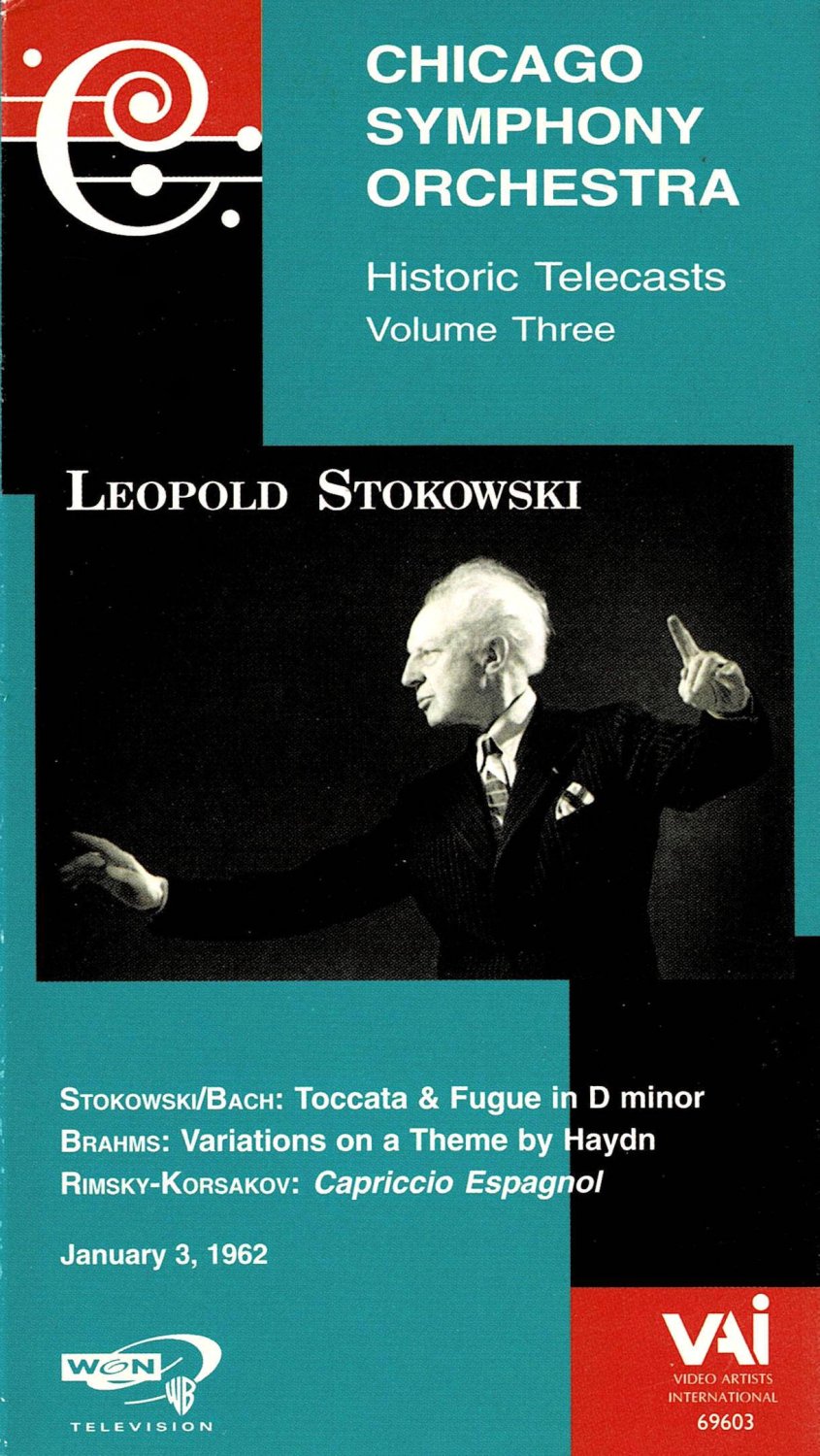
Chicago Symphony Orchestra Historic Telecasts Leopold Stokowski Volume 3 VHS Video
Only 1 available
Details
Shipping: US-Mainland: $5.95 (more destinations)
Condition: Used
Returns: does not accept (more)


Chicago Symphony Orchestra: Historic Telecasts, Volume Three - Leopold Stokowski!
This is a Rare and Hard to find video.
Stokowski/Bach: Toccata & Fugue in D minor
Brahms: Variations on a Theme by Haydn
Rimsky-Korsakov: Capriccio Espagnol
Telecast of January 3, 1962.
•Title: Chicago Symphony Orchestra
•Volume Three
•1999 Video Artists International, Inc.
•Format: VHS
•Running Time: 43 Minutes, B/W
•UPC: 089948696032
•Includes: Cardboard Slipcase
•Condition: Very Good
Stokowski/Bach: Toccata & Fugue in D minor 9:14
Brahms: Variations on a Theme by Haydn 17:13
Rimsky-Korsakov: Capriccio Espagnol, Op. 34 14:46
Chicago Symphony Orchestra, Leopold Stokowski, Conductor. January 3, 1962.
The celebrated conductor Leopold Stokowski (1882-1977) succeeded in many fields, including composition. He was most closely associated with the Philadelphia Orchestra, which he led for 24 years, and raised to the level of the world's greatest orchestras. Stokowski's colorful approach to music making made him the ideal choice for musical director of the Disney film Fantasia (1940).
Born in London (to a Polish father and an Irish mother), Stokowski studied organ, theory, and composition at the Royal College of Music there. In 1905, he assumed the post of organist and choirmaster at St. Bartholomew's in New York and ten years later became an American citizen. His association with the Philadelphia Orchestra, which began in 1912, brought him great adulation and some controversy as well, with debates surrounding his determination to introduce the works of contemporary composers such as Schoenberg, Webern, Berg, and Varese.
Stokowski's orchestral transcriptions of Bach were also open to debate among musical purists. Stokowski cited as his motivation the chance to popularize works of Bach which were not well known at the time. In retrospect, however, we can see that the transcriptions need no justification and stand on their own as compositions of brilliant invention.
Subsequent to his resignation from the Philadelphia Orchestra, Stokowski's varied activities included performances with the New York Philharmonic, the Houston Symphony Orchestra, the American Symphony Orchestra (which he founded), etc. Stokowski appeared with the Chicago Symphony Orchestra in six seasons between 1958 and 1968.
This is a Rare and Hard to find video.
Stokowski/Bach: Toccata & Fugue in D minor
Brahms: Variations on a Theme by Haydn
Rimsky-Korsakov: Capriccio Espagnol
Telecast of January 3, 1962.
•Title: Chicago Symphony Orchestra
•Volume Three
•1999 Video Artists International, Inc.
•Format: VHS
•Running Time: 43 Minutes, B/W
•UPC: 089948696032
•Includes: Cardboard Slipcase
•Condition: Very Good
Stokowski/Bach: Toccata & Fugue in D minor 9:14
Brahms: Variations on a Theme by Haydn 17:13
Rimsky-Korsakov: Capriccio Espagnol, Op. 34 14:46
Chicago Symphony Orchestra, Leopold Stokowski, Conductor. January 3, 1962.
The celebrated conductor Leopold Stokowski (1882-1977) succeeded in many fields, including composition. He was most closely associated with the Philadelphia Orchestra, which he led for 24 years, and raised to the level of the world's greatest orchestras. Stokowski's colorful approach to music making made him the ideal choice for musical director of the Disney film Fantasia (1940).
Born in London (to a Polish father and an Irish mother), Stokowski studied organ, theory, and composition at the Royal College of Music there. In 1905, he assumed the post of organist and choirmaster at St. Bartholomew's in New York and ten years later became an American citizen. His association with the Philadelphia Orchestra, which began in 1912, brought him great adulation and some controversy as well, with debates surrounding his determination to introduce the works of contemporary composers such as Schoenberg, Webern, Berg, and Varese.
Stokowski's orchestral transcriptions of Bach were also open to debate among musical purists. Stokowski cited as his motivation the chance to popularize works of Bach which were not well known at the time. In retrospect, however, we can see that the transcriptions need no justification and stand on their own as compositions of brilliant invention.
Subsequent to his resignation from the Philadelphia Orchestra, Stokowski's varied activities included performances with the New York Philharmonic, the Houston Symphony Orchestra, the American Symphony Orchestra (which he founded), etc. Stokowski appeared with the Chicago Symphony Orchestra in six seasons between 1958 and 1968.


