
$27.95
On Hold
1990 Corvette Sting Ray III Show Car Illustrated Series No. 86
More than 10 available
Details
Shipping: US-Mainland: $13.45 (more destinations)
Condition: Brand new
*The store has not been updated recently. You may want to contact the merchant to confirm the availability of the product.
Here's the story on this print:
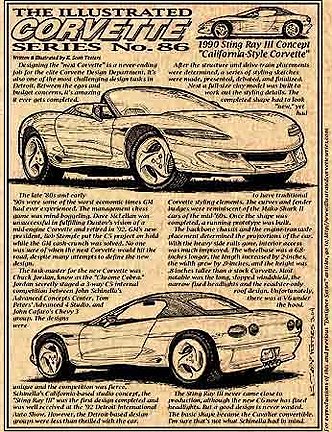
lllustrated Corvette Series No. 86 1990 Sting Ray III Concept Car
"California-Style Corvette"
Designing the "next Corvette" is a never-ending job for the elite Corvette Design Department. It's also one of the most challenging design tasks in Detroit. Between the egos and budget concerns, it's amazing it ever gets completed.
The late '80s and early '90s were some of the worst economic times GM had ever experienced. The management chess game was mind-boggeling. Dave McLellan was unsuccessful in fulfilling Duntov's vision of a mid-engine Corvette and retired in '92. GM's new president, Bob Stemple put the C5 project on hold while the GM cash-crunch was solved. No one was sure of when the next Corvette would hit the road, despite many attempts to define the new design.
The task-master for the new Corvette was Chuck Jordan, know as the "Chrome Cobra." Jordan secretly staged a 3-way C5 internal competition between John Schinella's Advanced Concepts Center, Tom Peters' Advanced 4 Studio, and John Cafaro's Chevy 3 group. The designs were unique and the competition was fierce. Schinella's California-based studio concept, the "Sting Ray III" was the first design completed and was well received at the '92 Detroit International Auto Show. However, the Detroit-based design groups were less than thrilled with the car.
After the structure and drive-train placements were determined, a series of styling sketches were made, presented, debated, and finalized. Next a full-size clay model was built to work out the styling details. The completed shape had to look "new," yet had to have traditional Corvette styling elements. The curves and fender budges were reminiscent of the Mako Shark II cars of the mid-'60s. Once the shape was completed, a running prototype was built.
The backbone chassis and the engine-transaxle placement determined the proportions of the car. With the heavy side rails gone, interior access was much improved. The wheelbase was a 6.8-inches longer, the length increased by 2-inches, the width grew by .9-inches, and the height was .8-inches taller than a stock Corvette. Most notable was the long, slopped windshield, the narrow fixed headlights and the roadster-only roof design. Unfortunately, there was a V6 under the hood.
The Sting Ray III never came close to production, although the new C6 now has fixed headlights. But a good design is never wasted. The basic shape became the Cavalier convertible. I'm sure that's not what Schinella had in mind.
_________________________________________________________________________________________________________________________________________________
Printed on high quality tan-colored parchment paper using a Xante professional grade printer.
This print comes in one size:
11” x 17”
Print is shrink wrapped on 11.5" x 17.5" cardboard so that they stay flat and clean and shipped via USPS Priority Mail. All prints are signed by the artist. They make a wonderful gift for the car lover in your life!
lllustrated Corvette Series No. 86 1990 Sting Ray III Concept Car
"California-Style Corvette"
Designing the "next Corvette" is a never-ending job for the elite Corvette Design Department. It's also one of the most challenging design tasks in Detroit. Between the egos and budget concerns, it's amazing it ever gets completed.
The late '80s and early '90s were some of the worst economic times GM had ever experienced. The management chess game was mind-boggeling. Dave McLellan was unsuccessful in fulfilling Duntov's vision of a mid-engine Corvette and retired in '92. GM's new president, Bob Stemple put the C5 project on hold while the GM cash-crunch was solved. No one was sure of when the next Corvette would hit the road, despite many attempts to define the new design.
The task-master for the new Corvette was Chuck Jordan, know as the "Chrome Cobra." Jordan secretly staged a 3-way C5 internal competition between John Schinella's Advanced Concepts Center, Tom Peters' Advanced 4 Studio, and John Cafaro's Chevy 3 group. The designs were unique and the competition was fierce. Schinella's California-based studio concept, the "Sting Ray III" was the first design completed and was well received at the '92 Detroit International Auto Show. However, the Detroit-based design groups were less than thrilled with the car.
After the structure and drive-train placements were determined, a series of styling sketches were made, presented, debated, and finalized. Next a full-size clay model was built to work out the styling details. The completed shape had to look "new," yet had to have traditional Corvette styling elements. The curves and fender budges were reminiscent of the Mako Shark II cars of the mid-'60s. Once the shape was completed, a running prototype was built.
The backbone chassis and the engine-transaxle placement determined the proportions of the car. With the heavy side rails gone, interior access was much improved. The wheelbase was a 6.8-inches longer, the length increased by 2-inches, the width grew by .9-inches, and the height was .8-inches taller than a stock Corvette. Most notable was the long, slopped windshield, the narrow fixed headlights and the roadster-only roof design. Unfortunately, there was a V6 under the hood.
The Sting Ray III never came close to production, although the new C6 now has fixed headlights. But a good design is never wasted. The basic shape became the Cavalier convertible. I'm sure that's not what Schinella had in mind.
_________________________________________________________________________________________________________________________________________________
Printed on high quality tan-colored parchment paper using a Xante professional grade printer.
This print comes in one size:
11” x 17”
Print is shrink wrapped on 11.5" x 17.5" cardboard so that they stay flat and clean and shipped via USPS Priority Mail. All prints are signed by the artist. They make a wonderful gift for the car lover in your life!


