
$5.99
Add to Cart
Operational Amplifiers and Linear Integrated Circuits Coughlin/Driscoll➤Prentice-Hall 1986 3rd Ed
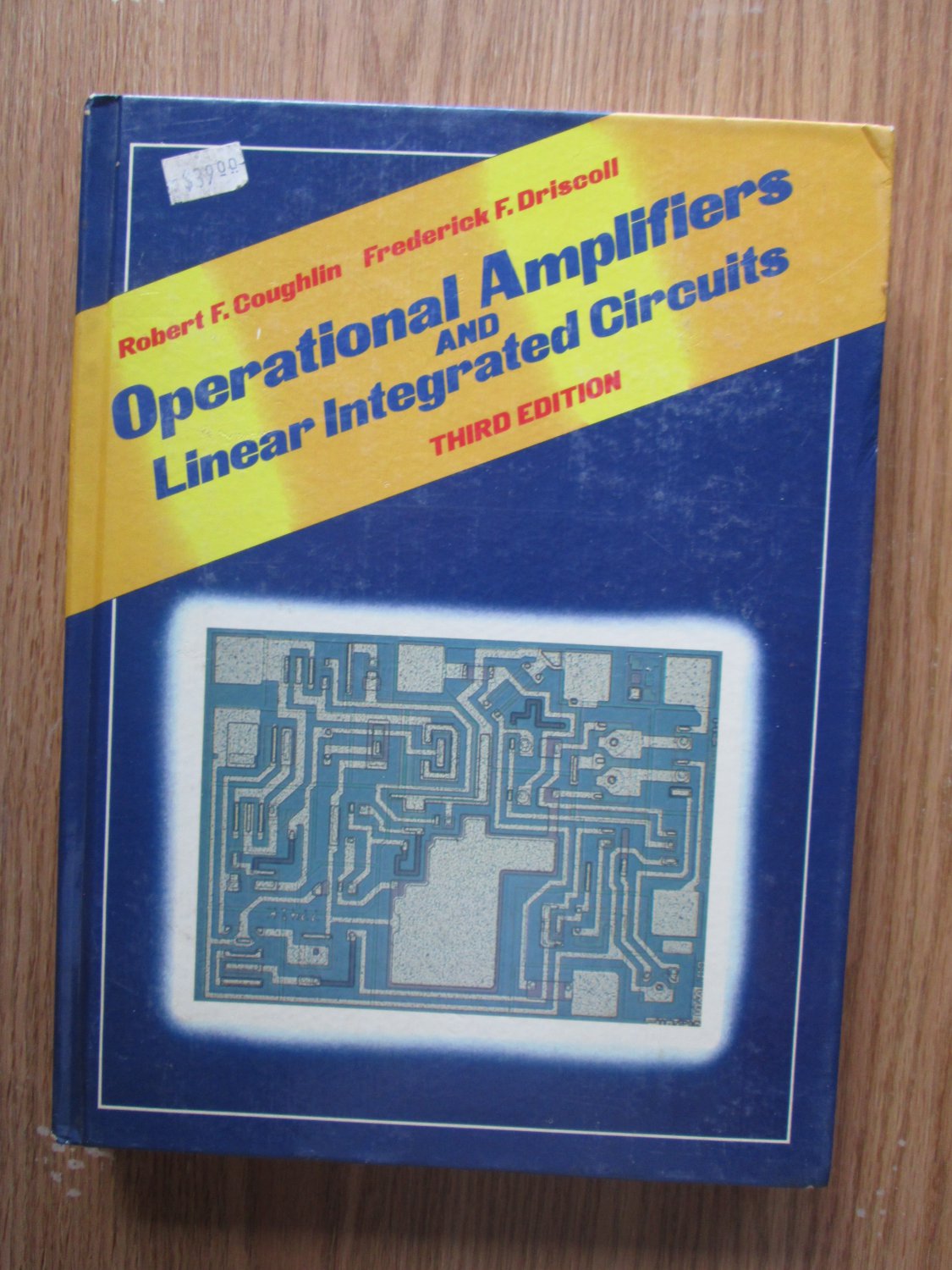


Operational Amplifiers and Linear Integrated Circuits by Robert F. Coughlin;Frederick F. Driscoll Prentice-Hall 1986 3rd Edition
Title: Operational Amplifiers and Linear Integrated Circuits
Author: Robert F. Coughlin;Frederick F. Driscoll
Format: Hardcover
Publisher: Prentice-Hall 1986
Edition: 3rd Edition
ISBN 10: 013637901X
Size: 7 X 9.5 X 1 * 455 pages
Synopsis: Preface - Operational amplifiers and other linear integrated circuits are both fun and easy to use, especially if the application does not require the devices to operate near their design limits. It is the purpose of this book to show just how easy they are to use in a variety of applications involving instrumentation, signal generation, filter, and control circuits.
When first learning how to use an op amp, one should not be presented with a myriad of op amps and asked to make an informed selection. For this reason, our introduction begins with an inexpensive, reliable op amp that forgives most mistakes in wiring, ignores long lead capacitance, and does not burn out easily. Such an op amp is the 741, whose characteristics are documented in Appendix 1 and whose applications are sprinkled throughout the text.
If a slightly faster op amp is needed for a wider bandwidth, another inexpensive and widely used op amp is the 301. See Appendix 2 for its electrical characteristics and Chapter 10 to learn when one might prefer the 301 over the 741.
Where appropriate, we have added specialized op amps: the LM339 single supply comparator in Chapter 2 and the LM311 high-performance comparator in Chapter 4. Where better dc performance is required, we have added BiFET op amps in Chapter 7
The third edition is organized into a set of core chapters that should be read first They are Chapters 1 through 6 and proceed in a logical teaching sequence to show how the op amp can be used to solve a variety of application problems.
The limitations of op amps are not discussed in Chapters 1 to 6 because it is very important to gain confidence in using op amps before pushing performance to its limits. When studying transistors or other devices, we do not begin with their limitations. Regrettably, much of the early literature on integrated circuits begins with their limitations and thus obscures the inherent simplicity and overwhelming advantages of basic integrated circuits over basic transistor circuits. For these reasons, op amp limitations are not presented until Chapters 9 and 10 for those readers who need to understand some of their limitations with respect to dc and ac performance. Furthermore, not all op amp limitations apply to every op amp circuit. For example, dc op amp limitations such as offset voltages are usually not important if the op amp is used in an ac amplifier circuit. Thus dc limitations (Chapter 9) are treated separately from ac limitations (Chapter 10).
The remaining chapters have been written to stand alone. They can be studied in any order after completion of Chapters 1 through 6.
Chapter 7 deals with the specialized applications that can best be accomplished by op amps combined with diodes.
Chapter 8 is concerned with problems of measuring physical variables such as force, pressure weight, and temperature. Bridge and instrumentation amplifiers are ideal for these
measurements.
Chapter 11 simplifies the design of active filters. The four basic types of active filters are shown: low-pass, high-pass, band-pass, and band-reject filters. Butterworth filters were selected because they are often used and easy to design. If you want to design a three-pole (60-dB/decade) Butterworth low- or high-pass filter, Chapter 11 tells you how to do it in four steps with a pencil and paper. No calculator or computer program is required. Basic algebra is the only mathematics that is required throughout the text.
A fascinating integrated circuit, the multiplier, is presented in Chapter 12 because it makes analysis and design of communication circuits very easy. Modulators, demod- ulators, frequency shifters, a universal AM radio receiver, and a host of other applications are performed by the multiplier, an op amp, and a few resistors.
Chapter 13 is included for those who need to use the ubiquitous 555 IC timer and also the XR2240 counter timer.
Since almost all linear integrated circuits require a regulated power supply, we have, because of requests from readers, rewritten Chapter 14. The latest IC regulators are used to show how you can make excellent linear regulated supplies at low cost for (a) 5-V digital logic ICs, (b) ±15-V linear ICs, (c) combined (a) and (b) for μP supplies, and (d) either positive or negative adjustable supplies.
This third edition has been extensively rewritten. Every chapter has been either fully or partially revised to substitute better circuits that have been found and to add more circuits that solve problems. We have incorporated suggestions from students, instructors, and practicing engineers from all parts of the United States and from Indonesia, Poland, Japan, and the USSR.
This edition contains more than enough material for a single-semester course. All circuits have been personally lab tested by the authors and their recommendations for laboratory work have been added to the end of each chapter. The material is suitable for both nonelectronic specialists who just want to learn something about linear ICs and for electronic majors who wish to use linear ICs.
We thank Mrs. Phyllis Wolff for the preparation of the revised manuscript. Our colleagues Robert S. Villanucci, William F. Megow, John Marchand, Richard Bean, Dominic Giampietro, and Alexander Avtgis have been particularly helpful with their suggestions, and testing of ideas.
We also thank two highly respected analog engineers, Dan Sheingold of Analog Devices and Bob Pease of National Semiconductors, for their constructive criticism, technical corrections, and guidance in areas we found difficult.
Finally, we thank our students for their insistence on relevant instruction that is immediately useful, and our readers for both their enthusiastic reception of this text and their perceptive comments.
ROBERT F. COUGHLIN
FREDERICK F. DRISCOLL
Boston, Mass.
Overall Condition: With the exception of the PO's name being lightly penciled in on the textblock edge this book is Very good: The book does not look new and has been read but is in excellent condition. There is no obvious damage to the pictorial cover and there is no dust jacket. There are no missing or damaged pages, no creases or tears, and no underlining/highlighting of text or writing in the margins. It may have very minimal identifying marks on the inside cover as well as very minimal wear and tear; see images.
Secure shipping bubble-wrapped in cardboard.
2026--U.S. shipping for this (Three Pounds Media Mail) is $5.86 with tracking.
Multiple items will be combined for the lowest shipping price.
International Shipping cost is based on the destination so inquire before buying. Mobile users must scroll to the bottom and click on 'use desktop site' to bring up the Ask a Question link which sends me an email.
(PLEASE CONTACT ME BEFORE MAKING ANY PAYMENT FROM OUTSIDE THE U.S.)
==========================================================================================================================
Just about all the books are USED books. Some have been used more gently than others. Some have been in libraries and have typical library extras. Some are so old and/or interesting that they are being offered for the sake of preservation regardless of the condition they are in. If the condition of the book is very important to you, please feel free to click the 'Ask seller a question' link and I will tell you more.
=========================================================================================
Title: Operational Amplifiers and Linear Integrated Circuits
Author: Robert F. Coughlin;Frederick F. Driscoll
Format: Hardcover
Publisher: Prentice-Hall 1986
Edition: 3rd Edition
ISBN 10: 013637901X
Size: 7 X 9.5 X 1 * 455 pages
Synopsis: Preface - Operational amplifiers and other linear integrated circuits are both fun and easy to use, especially if the application does not require the devices to operate near their design limits. It is the purpose of this book to show just how easy they are to use in a variety of applications involving instrumentation, signal generation, filter, and control circuits.
When first learning how to use an op amp, one should not be presented with a myriad of op amps and asked to make an informed selection. For this reason, our introduction begins with an inexpensive, reliable op amp that forgives most mistakes in wiring, ignores long lead capacitance, and does not burn out easily. Such an op amp is the 741, whose characteristics are documented in Appendix 1 and whose applications are sprinkled throughout the text.
If a slightly faster op amp is needed for a wider bandwidth, another inexpensive and widely used op amp is the 301. See Appendix 2 for its electrical characteristics and Chapter 10 to learn when one might prefer the 301 over the 741.
Where appropriate, we have added specialized op amps: the LM339 single supply comparator in Chapter 2 and the LM311 high-performance comparator in Chapter 4. Where better dc performance is required, we have added BiFET op amps in Chapter 7
The third edition is organized into a set of core chapters that should be read first They are Chapters 1 through 6 and proceed in a logical teaching sequence to show how the op amp can be used to solve a variety of application problems.
The limitations of op amps are not discussed in Chapters 1 to 6 because it is very important to gain confidence in using op amps before pushing performance to its limits. When studying transistors or other devices, we do not begin with their limitations. Regrettably, much of the early literature on integrated circuits begins with their limitations and thus obscures the inherent simplicity and overwhelming advantages of basic integrated circuits over basic transistor circuits. For these reasons, op amp limitations are not presented until Chapters 9 and 10 for those readers who need to understand some of their limitations with respect to dc and ac performance. Furthermore, not all op amp limitations apply to every op amp circuit. For example, dc op amp limitations such as offset voltages are usually not important if the op amp is used in an ac amplifier circuit. Thus dc limitations (Chapter 9) are treated separately from ac limitations (Chapter 10).
The remaining chapters have been written to stand alone. They can be studied in any order after completion of Chapters 1 through 6.
Chapter 7 deals with the specialized applications that can best be accomplished by op amps combined with diodes.
Chapter 8 is concerned with problems of measuring physical variables such as force, pressure weight, and temperature. Bridge and instrumentation amplifiers are ideal for these
measurements.
Chapter 11 simplifies the design of active filters. The four basic types of active filters are shown: low-pass, high-pass, band-pass, and band-reject filters. Butterworth filters were selected because they are often used and easy to design. If you want to design a three-pole (60-dB/decade) Butterworth low- or high-pass filter, Chapter 11 tells you how to do it in four steps with a pencil and paper. No calculator or computer program is required. Basic algebra is the only mathematics that is required throughout the text.
A fascinating integrated circuit, the multiplier, is presented in Chapter 12 because it makes analysis and design of communication circuits very easy. Modulators, demod- ulators, frequency shifters, a universal AM radio receiver, and a host of other applications are performed by the multiplier, an op amp, and a few resistors.
Chapter 13 is included for those who need to use the ubiquitous 555 IC timer and also the XR2240 counter timer.
Since almost all linear integrated circuits require a regulated power supply, we have, because of requests from readers, rewritten Chapter 14. The latest IC regulators are used to show how you can make excellent linear regulated supplies at low cost for (a) 5-V digital logic ICs, (b) ±15-V linear ICs, (c) combined (a) and (b) for μP supplies, and (d) either positive or negative adjustable supplies.
This third edition has been extensively rewritten. Every chapter has been either fully or partially revised to substitute better circuits that have been found and to add more circuits that solve problems. We have incorporated suggestions from students, instructors, and practicing engineers from all parts of the United States and from Indonesia, Poland, Japan, and the USSR.
This edition contains more than enough material for a single-semester course. All circuits have been personally lab tested by the authors and their recommendations for laboratory work have been added to the end of each chapter. The material is suitable for both nonelectronic specialists who just want to learn something about linear ICs and for electronic majors who wish to use linear ICs.
We thank Mrs. Phyllis Wolff for the preparation of the revised manuscript. Our colleagues Robert S. Villanucci, William F. Megow, John Marchand, Richard Bean, Dominic Giampietro, and Alexander Avtgis have been particularly helpful with their suggestions, and testing of ideas.
We also thank two highly respected analog engineers, Dan Sheingold of Analog Devices and Bob Pease of National Semiconductors, for their constructive criticism, technical corrections, and guidance in areas we found difficult.
Finally, we thank our students for their insistence on relevant instruction that is immediately useful, and our readers for both their enthusiastic reception of this text and their perceptive comments.
ROBERT F. COUGHLIN
FREDERICK F. DRISCOLL
Boston, Mass.
Overall Condition: With the exception of the PO's name being lightly penciled in on the textblock edge this book is Very good: The book does not look new and has been read but is in excellent condition. There is no obvious damage to the pictorial cover and there is no dust jacket. There are no missing or damaged pages, no creases or tears, and no underlining/highlighting of text or writing in the margins. It may have very minimal identifying marks on the inside cover as well as very minimal wear and tear; see images.
Secure shipping bubble-wrapped in cardboard.
2026--U.S. shipping for this (Three Pounds Media Mail) is $5.86 with tracking.
Multiple items will be combined for the lowest shipping price.
International Shipping cost is based on the destination so inquire before buying. Mobile users must scroll to the bottom and click on 'use desktop site' to bring up the Ask a Question link which sends me an email.
(PLEASE CONTACT ME BEFORE MAKING ANY PAYMENT FROM OUTSIDE THE U.S.)
==========================================================================================================================
Just about all the books are USED books. Some have been used more gently than others. Some have been in libraries and have typical library extras. Some are so old and/or interesting that they are being offered for the sake of preservation regardless of the condition they are in. If the condition of the book is very important to you, please feel free to click the 'Ask seller a question' link and I will tell you more.
=========================================================================================
Other Products from hobostew (View All)
-
$5.99

-
$4.99

-
$8.99

-
$9.99

-
$9.99

-
$6.99

-
$12.99

-
$7.99

-
$6.99

-
$6.99