
$12.50
On Hold
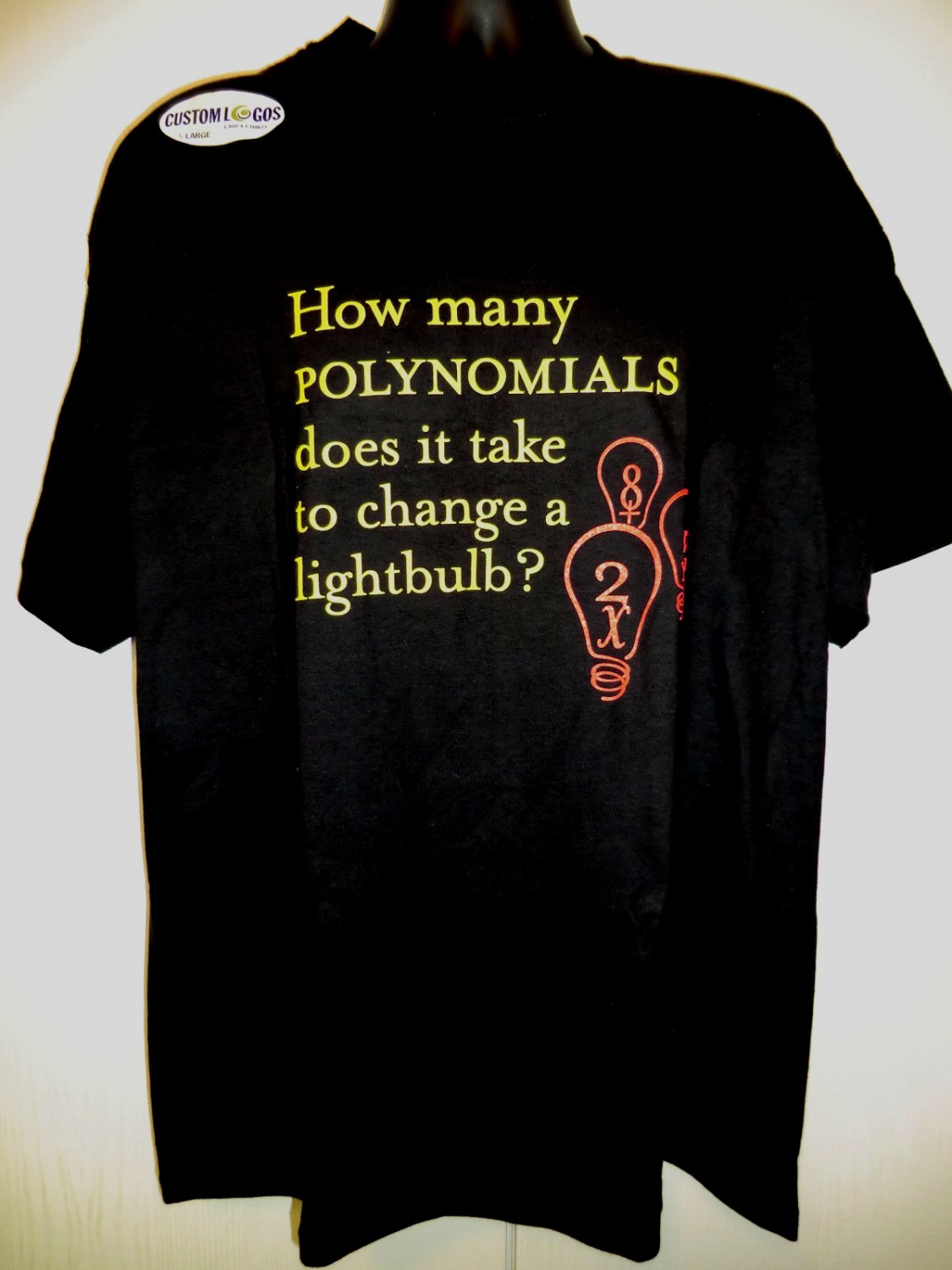
Funny MATH T-Shirt How many POLYNOMIALS does it take… NEW! Size XL
Only 1 available
Details
Shipping: US-Mainland: $4.50 (more destinations)
Condition: Brand new
*The store has not been updated recently. You may want to contact the merchant to confirm the availability of the product.


Here is a new (sticker still attached to the front of the T-Shirt) size XL black T-Shirt that has graphics on the front and back of the Tee. On the front silk-screened in goldenrod yellow it asks the question: How many POLYNOMIALS does it take to change a light bulb. On the back it says: PASS MATH with a “A� grade. The T-Shirt measures 24 ½ inches across the chest measured under the arms and from the back of the neck band to the bottom hem is 31 inches. A nice heavier 100% cotton T-Shirt with no holes or stains—NEW!
And just so you know...
Polynomial comes from poly- (meaning "many") and -nomial (in this case meaning "term") ... so it says "many terms".
http://en.wikipedia.org/wiki/Polynomial In mathematics, a polynomial is an expression constructed from variables (also called indeterminates) and constants (usually numbers, but not always), using only the operations of addition, subtraction, multiplication, and non-negative integer exponents (which are equivalent to several multiplications by the same value). However, the division by a constant is allowed, because the multiplicative inverse of a non-zero constant is also a constant. For example, x2 − x/4 + 7 is a polynomial, but x2 − 4/x + 7x3/2 is an algebraic expression that is not a polynomial, because its second term involves a division by the variable x (the term 4/x), and also because its third term contains an exponent that is not a non-negative integer (3/2).
And just so you know...
Polynomial comes from poly- (meaning "many") and -nomial (in this case meaning "term") ... so it says "many terms".
http://en.wikipedia.org/wiki/Polynomial In mathematics, a polynomial is an expression constructed from variables (also called indeterminates) and constants (usually numbers, but not always), using only the operations of addition, subtraction, multiplication, and non-negative integer exponents (which are equivalent to several multiplications by the same value). However, the division by a constant is allowed, because the multiplicative inverse of a non-zero constant is also a constant. For example, x2 − x/4 + 7 is a polynomial, but x2 − 4/x + 7x3/2 is an algebraic expression that is not a polynomial, because its second term involves a division by the variable x (the term 4/x), and also because its third term contains an exponent that is not a non-negative integer (3/2).
You may also be interested in:
-
$10.00

-
$10.00

-
$10.00

-
$16.99

-
$10.00

-
$10.00

-
$10.00

-
$10.00

-
$10.00

-
$10.00


