
$19.99
Add to Cart
SOS PACIFIC S.O.S. Original POLISH Poster PIER ANGELI Richard Attenborough 1959
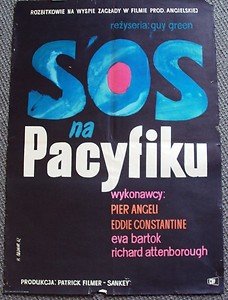


Great ORIGINAL Polish Poster measuring 22” x 33” featuring off beat art quite different than the American Movie Poster, printed on Kraft Paper, which is what POLISH film posters are known for, unique art and colors on Kraft Paper. This Poster has some edgwear tiny tears and center fold and was usedto promote the 1959 Drama,SOS PacificA flying boat has to ditch off an island in the Pacific. Along with the injured owner-pilot the passengers include a policeman and his smuggler prisoner, a slimey limey witness against him, a physicist, and a globe-hopping good-time girl. On the island they find a fleet of derelict ships, farm animals tethered, and cameras in a lead-lined bunker and a stark realisation soon dawns. Director:Guy GreenWriters:Bryan Forbes (additional scenes and dialogue), Robert Westerby (screenplay) Stars:Richard Attenborough, Pier Angeli, John GregsonCastRichard Attenborough... Whitey Mullen Pier Angeli... Teresa John Gregson... Captain John 'Jack' Bennett Eva Bartok... Maria Eddie Constantine... Mark Gunnar Möller... Dr. Strauss Jean Anderson... Miss Shaw Cec Linder... WillyClifford Evans... Peterson Harold Kasket... Monk (as Harold Kaskett) Andrew Faulds... Sea Captain Poster has an UNUSUAL image, of an S.O.S. logo. It's in good shape except for the edges and center fold,regardless the thin kraft paper, they usually tear, it's the nature of the beast. Amazing it was saved over50 years old! Sold as Is, would look great framed!Shop with confidence! This is part of our in-store inventory from our shop which is has been located in the heart of Hollywood where we have been in business for OVER40 years!MORE INFO ON PIER ANGELI: Anna Maria Pierangeli was born June 19, 1932, in Cagliari, Sardinia, Italy. Anna and her twin sister, Marisa Pavan, both had their eyes on become film stars, since that was one of the big Italian pastimes. Anna adopted her surname and split it in half, and it was as Pier Angeli that she would find fame. Her first role was an uncredited part in 1948's The Million Dollar Nickel (1952), an Italian production. Pier was 16 at the time and it was to be the first of many roles for this beautiful woman. The film was largely forgettable but it was a start. The following year she played in another Italian production, Tomorrow Is Too Late (1950). Again it was a very small role, and she was not seen on the screen again until 1951. Between 1949 and 1951 she appeared in stage productions and found work in menial jobs. When she did return it was in the film The Light Touch (1952) as Anna Vasarri. Later that year she won the title role in Teresa (1951). However, she again hit a drought with only one film in 1952 and two in 1953. The next year things began to pick up, however, with Hollywood beckoning at her door. After the Italian Mam'zelle Nitouche (1954) she caught the eyes of Hollywood moguls, who cast her in Flame and the Flesh (1954) and The Silver Chalice (1954). Now she divided her time between Italy and the US making movies. She married Vic Damone in 1954, a union that lasted only four years and produced one son.No film offers came in 1955, but in 1956 Pier landed the plum role of Norma Graziano (wife of fighter Rocky Graziano) in Somebody Up There Likes Me (1956) opposite Paul Newman. The film was well received at the box office and she had hopes that things were going to pick up again. She played Ynez in Port Afrique (1956) later that year and then another drought ensued. After The Vintage (1957), Merry Andrew (1958) and SOS Pacific (1959), she made three more films in 1960. Then once again 1961 saw no appearances. In 1962 Pier played Ildith in Sodom and Gomorrah (1962) and later that year played in a French production entitled White Slave Ship (1961). After the Italian production of Panic in Bangkok (1964) she returned in the hit European-American co-production Battle of the Bulge (1965).After a handful of films between 1966 and 1970, Pier realized her dreams of superstardom were not to be. She had divorced her second husband (Armando Trovajoli) in 1969 and made her final appearance on the screen in 1971 in the low-budget sci-fi opus Octaman (1971). On September 10 of that year Pier was found dead of a barbiturate overdose in her Beverly Hills home. She was only 39 years old.MORE INFO ON RICHARD ATTENBOROUGH: Lord Richard Attenborough was born in Cambridge, England, the son of Mary (née Clegg), a founding member of the Marriage Guidance Council, and Frederick Levi Attenborough, a scholar and academic administrator who was a don at Emmanuel College and wrote a standard text on Anglo-Saxon law. Attenborough was educated at Wyggeston Grammar School for Boys in Leicester and at the Royal Academy of Dramatic Art (RADA).His film career began with a role as a deserting sailor in In Which We Serve (1942), a part that contributed to his being typecast for many years as a coward in films like Dulcimer Street (1948), Operation Disaster (1950) and his breakthrough role as a psychopathic young gangster in the film adaptation of Graham Greene's novel, Brighton Rock (1947). During World War II Attenborough served in the Royal Air Force.He worked prolifically in British films for the next 30 years, and in the 1950s appeared in several successful comedies for John Boulting and Roy Boulting, including Private's Progress (1956) and I'm All Right Jack (1959). Early in his stage career, Attenborough starred in the London West End production of Agatha Christie's "The Mousetrap", which went on to become one of the world's longest-running stage productions. Both he and his wife were among the original cast members of the production, which opened in 1952 and (as of 2007) is still running.In the 1960s he expanded his range of character roles in films such as Seance on a Wet Afternoon (1964) and Guns at Batasi (1964), for which he won the BAFTA Award for Best Actor for his portrayal of the regimental Sergeant Major. He appeared in the ensemble cast of The Great Escape (1963), as Squadron Leader Roger Bartlett ("Big X"), the head of the escape committee.In 1967 and 1968 he won back-to-back Golden Globe Awards in the category of Best Supporting Actor, the first time for The Sand Pebbles (1966) starring Steve McQueen, and the second time for Doctor Dolittle (1967) starring Rex Harrison. He would win another Golden Globe for Best Director, for Gandhi (1982), in 1983. Six years prior to "Gandhi" he played the ruthless Gen. Outram in Indian director Satyajit Ray's period piece The Chess Players (1977). He has never been nominated for an Academy Award in an acting category.He took no acting roles following his appearance in Otto Preminger's The Human Factor (1979) until his appearance as the eccentric developer John Hammond in 'Steven Spielberg (I)''s Jurassic Park (1993). The following year he starred as Kris Kringle in Miracle on 34th Street (1994), a remake of the 1947 classic. Since then he has made occasional appearances in supporting roles including the historical drama Elizabeth (1998) as Sir William Cecil.In the late 1950s Attenborough formed a production company, Beaver Films, with Bryan Forbes and began to build a profile as a producer on projects including The League of Gentlemen (1960), The Angry Silence (1960) and Whistle Down the Wind (1961), also appearing in the first two of these as an actor.His feature film directorial debut was the all-star screen version of the hit musical Oh! What a Lovely War (1969), and his acting appearances became more sporadic - the most notable being his portrayal of serial killer John Christie in 10 Rillington Place (1971). He later directed two epic period films: Y_oung Winston (1972)_, based on the early life of 'Winston Churchill', and A Bridge Too Far (1977), an all-star account of Operation Market Garden in World War II. He won the 1982 Academy Award for Directing for his historical epic "Gandhi", a project he had been attempting to get made for many years. As the film's producer, he also won the Academy Award for Best Picture. His most recent films as director and producer include Chaplin (1992) starring Robert Downey Jr. as Charles Chaplin and Shadowlands (1993), based on the relationship between C.S. Lewis and Joy Gresham. Both films starred 'Anthony Hopkins (I)', who also appeared in three other films for Attenborough: "Young Winston", "A Bridge Too Far" and the thriller Magic (1978).Attenborough also directed the screen version of the hit Broadway musical :A Chorus Line" (A Chorus Line (1985)) and the apartheid drama Cry Freedom (1987), based on the experiences of Donald Woods. He was nominated for a Golden Globe Award for Best Director for both films. His most recent film as director was another biographical film, Grey Owl (1999), starring Pierce Brosnan.Attenborough is the President of RADA, Chairman of Capital Radio, President of BAFTA, President of the Gandhi Foundation, and President of the British National Film and Television School. He is also a vice patron of the Cinema and Television Benevolent Fund.He is also the patron of the UWC movement (United World Colleges), whereby he continually contributes greatly to the colleges that are part of the organization. He has frequented the United World College of Southern Africa(UWCSA) Waterford Kamhlaba. His wife and he founded the Richard and Sheila Attenborough Visual Arts Center. He also founded the Jane Holland Creative Center for Learning at Waterford Kamhlaba in Swaziland in memory of his daughter who died in the Tsunami on Boxing day, 2004. He passionately believes in education, primarily education that does not judge upon color, race, creed or religion. His attachment to Waterford is his passion for non-racial education, which were the grounds on which Waterford Kamhlaba was founded. Waterford was one of his inspirations for directing "Cry Freedom",based on the life of Steve Biko.He was elected to the post of Chancellor of the University of Sussex on 20 March 1998, replacing the Duke of Richmond and


