
$32.95
On Hold
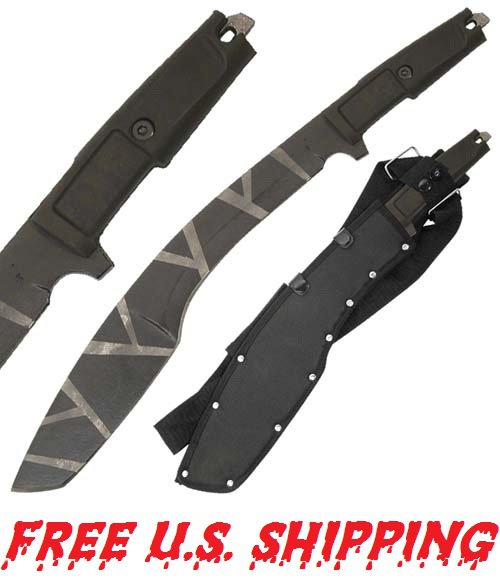
Gurkha Soldier Military Combat War Kukri Camping Jungle Bush Machete Knife Blade


2 available, 1 sold
Details
Shipping: US-Mainland: free (more destinations)
Condition: Brand new
*The store has not been updated recently. You may want to contact the merchant to confirm the availability of the product.
Gurkha Jungle Machete Knife
(HK-6269)
FREE SHIPPING IN THE LOWER 48 U.S. STATES
ALASKA, HAWAII, U.S. TERRITORIES FLAT SHIPPING $9.95
INTERNATIONAL SHIPPING CONTACT US AT [email protected] FOR A SHIPPING QUOTE BEFORE YOU BUY
This Military Grade Kukri Machete Camouflage sports a 7mm thick High Carbon Steel full tang construction. The Machete features a Tanto style black and silver blade with an antique rough finish. This knife will makes someone feel the chills up their spine. The blade can be sharpened even more for the perfect cutting. You can do pretty much anything to this Military Grade Kukri Machete without the blade being severed.
The full tang handle construction will give you the security of chopping without the blade and handle falling apart. The rubberized handle sports a black rubber finish with a tang pin in the middle holding both sides of the rubber handle. So don’t worry, it will not slip out of your hands. The end of the handle features a lanyard hold for assuring your security when using this Machete. The Tanto provides the extra cutting blade when needed. This Machete comes equipped with a black nylon sheath with snaps and 36 inch Velcro belt strap. The outdoors will never be the same with the security of this Camouflage Military Grade Kukri Tanto Machete.
Specifications:
Overall length: 18.5 inch
Blade Length: 13.5 inch
Handle Length: 5 inch
Blade Material: High Carbon Steel
Blade Thickness: 7mm
Handle Material: Full Tang with Rubberized Finish, Lanyard Hole
Includes: Black Nylon Sheath with 36 inch Belt Strap
ABOUT THE KUKRI: The kukri (also sometimes spelled khukri or khukuri) is a curved Nepalese knife used as both tool and weapon. It is also a part of the regimental weaponry and heraldry of The Royal Gurkha Rifles. It is known to many people as simply the "Gurkha Blade" or "Gurkha Knife". Also widely used in the Kumaon region of Uttarakhand state of India, where it is called Kaanta or Dafya (in Kumaoni). It is a matter of debate where the design came into Nepal from another or who promoted it first. It may be indigenous to the Indian region, but ancient Egypt, the Iberians, and the Greeks used similar designs. One weapon of Iberian origin, the Falcata, shows some similarity with the kukri, and the Greeks used forms called the Machaira and kopis. Alexander the Great's men used weapons of this type and may have spread it into India when Alexander moved into the Punjab. The Greek kings in Afghanistan and India in later centuries who had relation with Mediterranean culture (after the time of Julius Caesar and Roman merchants, who had a huge commercial presence in India) seem to have used tools similar to kukri, and possibly were promoters of it. It is not documented if the Aryans had similar tool at that time. Eurasian steppe people, the Turks used a type of forward-curving Turkish sword yataghan (mid-16th to late 19th centuries) which first appeared in centuries after the Battle of Manzikert and looked similar to kukri. Gurkha troops were issued the kukri and regularly trained in its use. The weapon was used in combat in both World War I and World War II, where it earned a deadly reputation among enemy forces. During the Second World War, the kukri was purchased and used by other British, Commonwealth, and U.S. troops training in India, including the Chindits and Merrill's Marauders.
(HK-6269)
FREE SHIPPING IN THE LOWER 48 U.S. STATES
ALASKA, HAWAII, U.S. TERRITORIES FLAT SHIPPING $9.95
INTERNATIONAL SHIPPING CONTACT US AT [email protected] FOR A SHIPPING QUOTE BEFORE YOU BUY
This Military Grade Kukri Machete Camouflage sports a 7mm thick High Carbon Steel full tang construction. The Machete features a Tanto style black and silver blade with an antique rough finish. This knife will makes someone feel the chills up their spine. The blade can be sharpened even more for the perfect cutting. You can do pretty much anything to this Military Grade Kukri Machete without the blade being severed.
The full tang handle construction will give you the security of chopping without the blade and handle falling apart. The rubberized handle sports a black rubber finish with a tang pin in the middle holding both sides of the rubber handle. So don’t worry, it will not slip out of your hands. The end of the handle features a lanyard hold for assuring your security when using this Machete. The Tanto provides the extra cutting blade when needed. This Machete comes equipped with a black nylon sheath with snaps and 36 inch Velcro belt strap. The outdoors will never be the same with the security of this Camouflage Military Grade Kukri Tanto Machete.
Specifications:
Overall length: 18.5 inch
Blade Length: 13.5 inch
Handle Length: 5 inch
Blade Material: High Carbon Steel
Blade Thickness: 7mm
Handle Material: Full Tang with Rubberized Finish, Lanyard Hole
Includes: Black Nylon Sheath with 36 inch Belt Strap
ABOUT THE KUKRI: The kukri (also sometimes spelled khukri or khukuri) is a curved Nepalese knife used as both tool and weapon. It is also a part of the regimental weaponry and heraldry of The Royal Gurkha Rifles. It is known to many people as simply the "Gurkha Blade" or "Gurkha Knife". Also widely used in the Kumaon region of Uttarakhand state of India, where it is called Kaanta or Dafya (in Kumaoni). It is a matter of debate where the design came into Nepal from another or who promoted it first. It may be indigenous to the Indian region, but ancient Egypt, the Iberians, and the Greeks used similar designs. One weapon of Iberian origin, the Falcata, shows some similarity with the kukri, and the Greeks used forms called the Machaira and kopis. Alexander the Great's men used weapons of this type and may have spread it into India when Alexander moved into the Punjab. The Greek kings in Afghanistan and India in later centuries who had relation with Mediterranean culture (after the time of Julius Caesar and Roman merchants, who had a huge commercial presence in India) seem to have used tools similar to kukri, and possibly were promoters of it. It is not documented if the Aryans had similar tool at that time. Eurasian steppe people, the Turks used a type of forward-curving Turkish sword yataghan (mid-16th to late 19th centuries) which first appeared in centuries after the Battle of Manzikert and looked similar to kukri. Gurkha troops were issued the kukri and regularly trained in its use. The weapon was used in combat in both World War I and World War II, where it earned a deadly reputation among enemy forces. During the Second World War, the kukri was purchased and used by other British, Commonwealth, and U.S. troops training in India, including the Chindits and Merrill's Marauders.


